



















Every PC gamer knows the ritual. You buy a new game, you sit down on a Friday night, you hit launch — and you’re greeted by a progress bar that says “Compiling shaders.” Three minutes later you’re still watching it crawl. Then, twenty minutes into actual gameplay, the game hitches hard right as a firefight kicks off, because some shader the engine forgot to precompile decided to build itself mid-frame. I’ve been building and testing rigs for over fifteen years, and shader stutter is one of the few problems that has gotten worse over time, not better, as engines like Unreal 5 pile on more pipeline state objects than any system can realistically enumerate ahead of time.
Advanced Shader Delivery — ASD — is Microsoft’s attempt to make that whole ritual disappear. And based on the first real on-versus-off testing that’s surfaced, it actually works. Mostly.
What Advanced Shader Delivery Actually Does
The short version: instead of your machine compiling shaders locally the first time you launch a game, ASD ships precompiled shaders to you as part of the download, the same way the game streams down its textures and audio. No local compile pass, no loading-screen tax, and — in theory — no compilation stutter during play.
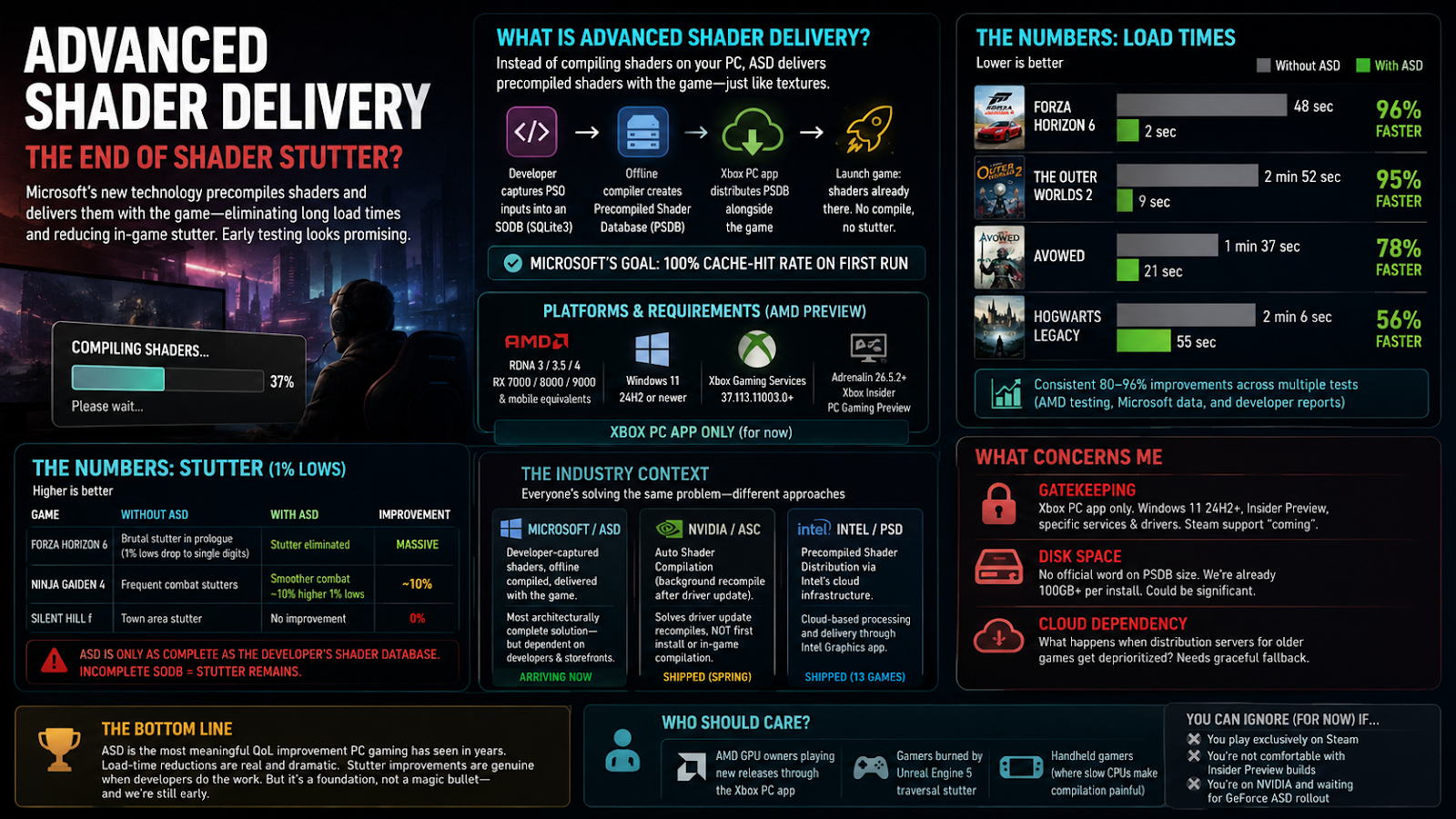
The mechanics are more interesting than the marketing. Developers programmatically capture pipeline state object inputs into a new asset called a State Object Database, an SODB, which is literally a SQLite3 file holding the shaders plus the structure for grouping them into PSOs. That database then gets run through an offline compiler — and this is the clever bit — which doesn’t need the target GPU physically present to do its work. The output is a precompiled shader database, a PSDB, that the Xbox PC app registers and distributes alongside the game. Boot the game, the system sees the shaders already exist, skips the compile step entirely. Microsoft’s stated ceiling is a 100% cache-hit rate on first run, which would nuke both long loads and in-game stutter in one move.
ASD first showed up on the ROG Xbox Ally handhelds last year alongside AMD’s Z-series chips, got folded into the DirectX Agility SDK at GDC 2026, and as of the Adrenalin 26.5.2 driver it’s now in public preview for desktop and laptop AMD GPUs — RDNA 3, RDNA 3.5, and RDNA 4, covering the RX 7000, 8000, and 9000 families plus their mobile equivalents.
The Numbers: Where It Delivers and Where It Doesn’t
Here’s the part that matters. Tom’s Hardware ran the first proper on/off comparison I’ve seen, using a PowerColor RX 9070 XT paired with a Ryzen 7 9800X3D, across six games picked specifically for being notorious shader offenders. The results split into two clean buckets.
On load times, ASD is borderline ridiculous. Per their testing, Forza Horizon 6 dropped from 48 seconds to 2 — a 96% cut. The Outer Worlds 2 went from 2 minutes 52 seconds down to 9 seconds. Avowed shaved 78% off its load, and Hogwarts Legacy 56%. Microsoft’s own DirectX blog quotes similar figures from the developer side, claiming Forza Horizon 6 loads in 4 seconds versus roughly 90 on an RX 7600, and that Avowed saw launch times cut by as much as 85% in Obsidian’s internal testing. The fact that three independent measurements all land in the same 80-96% ballpark tells you this isn’t a cherry-picked demo number.
Stutter is the messier story. In Forza Horizon 6, that brutal first-run prologue hitch — the kind that can drag a 1% low down to single digits — was simply gone with ASD on. Ninja Gaiden 4 had a couple of combat stutters that ASD smoothed out, worth roughly a 10% bump in 1% lows per the same testing, and Tom’s Hardware’s headline cites up to a 33% improvement in worst-case 1% lows. But Silent Hill f? ASD did nothing for its town-area stutter. Whether that’s an API limitation or the developer simply not capturing every shader into the SODB isn’t clear, but it’s the most important data point in the whole exercise: ASD is only as complete as the shader database the developer feeds it. Garbage in, stutter out.
The Industry Context: Everyone’s Solving the Same Problem Differently
What makes ASD more than a one-vendor curiosity is that the entire GPU industry has independently decided shader stutter is the hill to die on, and they’re all climbing it from different sides.
NVIDIA shipped “Auto Shader Compilation” in the NVIDIA App back in spring — but read the fine print, because it solves a narrower problem. ASC recompiles shaders in the background after a driver update so you don’t eat the recompile penalty next launch. Per NVIDIA’s own framing, it does nothing for the first-install compile or for shaders built on the fly during gameplay. It’s a bridge, not a destination, and NVIDIA has said it’s working with Microsoft to bring true ASD to GeForce later this year.
Intel went a different route entirely with “Precompiled Shader Distribution,” a cloud-based system that processes shaders on Intel’s own servers and pushes them down through the Intel Graphics app. Per coverage of its launch, it shipped supporting 13 games with load-time improvements ranging from 1.3x to 21x. Different plumbing, same goal.
So you’ve got Microsoft’s developer-captured, download-bundled approach (ASD), NVIDIA’s local background recompile (ASC), and Intel’s server-side cloud distribution (PSD). My read after watching this space for a while: ASD is the most architecturally sound of the three because the work happens offline and arrives with the game, but it’s also the one with the most dependencies — and that’s the catch.
What Concerns Me
I don’t get excited about a feature until I’ve thought about how it breaks, and ASD has a few failure modes worth flagging before you go chasing it.
First, the gatekeeping. Right now ASD is Xbox PC app only. You need Windows 11 24H2 or newer, Xbox Gaming Services 37.113.11003.0+, enrollment in the Xbox Insider PC Gaming Preview, and Adrenalin 26.5.2 or later. That’s a lot of hoops, and it means your Steam library — i.e. where most of us actually buy games — sees none of this yet. Microsoft says other storefronts are coming. I’ll believe it when I see a Steam title light up “Precompiled shaders installed.”
Second, disk space. Nobody in the official materials has said how much storage these PSDBs eat, and we’re already routinely past 100GB per install. A commenter on the original testing asked exactly this and got no answer. If precompiled-shader databases scale with resolution or hardware permutations, that’s a real planning concern for anyone on a modest SSD.
Third, the cloud dependency. The whole model leans on a distribution pipeline being there when you need it. What happens to a five-year-old game’s PSDB when the servers hosting it get deprioritized? Local compilation is slow and annoying, but it’s yours and it works offline forever. I’d want to see a graceful fallback baked in before this becomes the only path.
The Bottom Line
Strip away the preview-program friction and ASD is the most meaningful quality-of-life improvement PC gaming has gotten in years — and I don’t say that lightly, because the platform-level fix for shader stutter is something we’ve been promised and denied for the better part of a decade. The load-time numbers are real, reproduced across multiple independent measurements, and the stutter reduction is genuine in the titles where developers do the work properly.
But “where developers do the work properly” is carrying a lot of weight in that sentence. Silent Hill f is the cautionary tale: the technology can be present and still do nothing if the shader database is incomplete. ASD isn’t a magic toggle you flip to fix every stuttery game in your backlog. It’s a framework that’s only as good as the developers and storefronts feeding it — and right now, very few are. This is the foundation of something that could genuinely make “compiling shaders” a phrase we explain to younger gamers someday. We’re just not there yet.
Who Should Read This
You should care about ASD if you’re an AMD GPU owner who plays new releases through the Xbox PC app, if you’ve been burned by Unreal Engine 5 traversal stutter, or if you’re a handheld gamer where slow CPUs make local compilation especially painful. You can safely ignore it for now if you live entirely in Steam, if you’re not comfortable running Insider preview builds, or if you’re on an NVIDIA card and waiting for the GeForce ASD rollout — for you, this is a “watch this space” situation, not an “act today” one.